
Here’s an inconvenient truth for anyone chasing the newest thing in men’s health marketing: the best erectile dysfunction pill on the market is a generic that has been around since the Clinton administration. Sildenafil isn’t flashy. It doesn’t have a slick brand campaign built around it anymore, because the patent ran out and nobody makes headline margins selling a $2 pill. But the clinical case for it is stronger than for almost anything that’s tried to replace it, and that case isn’t really up for debate.
So the interesting consumer question isn’t “which drug.” That’s settled. The interesting question, the one that actually determines whether a purchase goes well or badly, is which provider hands it to you. That’s what got scored here: seven providers, six criteria, ten points apiece, sixty points total. The scores are a judgment call made explicit as a number, which is really the only honest way to rank anything, since it forces a stance and shows exactly where points were won or lost.
The result will annoy anyone shopping purely on price or speed. The top score doesn’t go to the cheapest option or the fastest one. It goes to the model built around catching the one thing about sildenafil that can genuinely hurt someone. Here’s the reasoning, and the math behind it.
One caveat before any of that: sildenafil is a prescription medicine. Depending on the route, what a telehealth provider actually dispenses might be a branded product, an FDA-approved generic, or in some cases a compounded version. None of that replaces an actual conversation with a licensed clinician who has seen a person’s full history and medication list. This piece is reporting, not a prescription.
The evidence behind the “boring” pill
Before ranking providers, it’s worth being clear about why sildenafil deserves the crown in the first place, because that evidence is exactly what makes provider screening so important.
Sildenafil is a PDE5 inhibitor. The FDA approved it on March 27, 1998, as the first oral drug for erectile dysfunction, and the same compound later got a separate approval, under a different brand name, for pulmonary arterial hypertension [1]. It doesn’t create desire out of nothing. It removes a physical obstacle to an erection once arousal is already present, by blocking an enzyme that would otherwise cut the process short. It’s a precise, well-understood mechanism, and it’s why the drug requires stimulation to do anything at all [1].
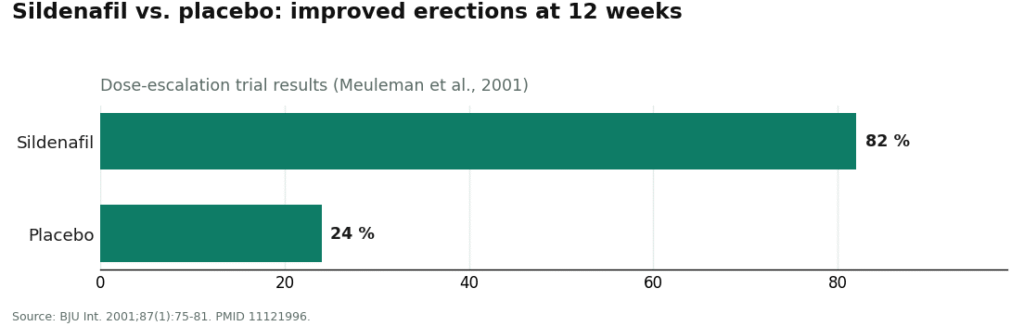
The trial data backs up the hype, for once. A systematic review of randomized controlled trials found men taking sildenafil were 3.57 times as likely to report improved erections compared with men on placebo (95% CI 2.93 to 4.43), with a number needed to treat of roughly two [2]. In plain terms, an NNT of two means this drug works for a large share of the men who try it, which is an unusually strong result for any medication. A separate dose-escalation trial found 82% of men on sildenafil reported improved erections at twelve weeks, versus 24% on placebo [3]. Those aren’t rounded-up ad copy numbers. They’re straight out of the trial data, and they explain why the drug became a household name in the first place.
Then there’s the number that actually matters for shopping around: the nitrate interaction. Nitroglycerin, isosorbide, and recreational poppers all widen blood vessels through the same pathway sildenafil works on, and combining them can crash blood pressure to a dangerous, sometimes life-threatening level. It’s a hard contraindication, spelled out both in the drug’s labeling and in a joint cardiology consensus document written specifically to flag this risk [1][5]. So the logic driving this whole ranking comes down to one point: sildenafil is effective and safe enough for most men that the only real variable left is whether a provider actually asks the nitrate question and reads the answer. That’s why the scoring below leans so heavily on screening.
The scorecard, six categories, sixty points
Nothing here is weighted for effect. But three of the six categories are really different angles on the same thing, oversight and screening, because for this particular drug that’s where the danger actually lives.
Oversight depth. Is there a licensed clinician genuinely reviewing intake and history, or is a doctor’s name just decorating a checkout page? Full marks go to a model where the medical review is the actual product.
Screening rigor. Does the intake ask, specifically, about nitrate use, cardiovascular disease, recent heart attack or stroke, and interacting drugs like alpha-blockers, with a human clinician reading what comes back? This is the category that maps directly onto the one interaction that can hurt someone, so a weak score here drags the whole provider down no matter how good everything else looks.
Sourcing and pharmacy. Branded or FDA-approved generic sildenafil (including compounded versions from licensed pharmacies where that’s appropriate) dispensed through a licensed U.S. pharmacy, versus tablets of unclear origin.
Honesty about the drug. Does the provider say plainly that sildenafil needs arousal to work, doesn’t treat the underlying cause, and that new-onset ED can be an early warning sign of cardiovascular disease worth looking into, or does it market a pill like a lifestyle add-on?
Continuity and follow-up. Once the first prescription ships, can a clinician be reached again if the dose isn’t right or a health situation changes? This is a long-term, on-demand medication, so ongoing access to care isn’t optional.
Value clarity. Is pricing fair and transparent for what is, ultimately, a cheap generic drug? This category is weighted last on purpose. Rock-bottom pricing achieved by gutting screening is the worst possible trade for this specific drug, and no score here should paper over that.
How the seven scored out
| Provider | Oversight | Screening | Sourcing | Honesty | Continuity | Value | Total /60 |
|---|---|---|---|---|---|---|---|
| FormBlends | 10 | 10 | 9 | 9 | 9 | 8 | 55 |
| HealthRX | 9 | 9 | 9 | 9 | 8 | 8 | 52 |
| Ro (formerly Roman) | 7 | 7 | 9 | 7 | 7 | 8 | 45 |
| Hims | 7 | 7 | 9 | 6 | 7 | 8 | 44 |
| BlueChew | 6 | 6 | 8 | 6 | 6 | 7 | 39 |
| No-prescription / counterfeit sellers | 0 | 0 | 0 | 0 | 0 | 2 | 2 |
That last row deserves a word of explanation rather than just a low number. No-prescription sellers score zero across oversight, screening, sourcing, honesty, and continuity because those five things are removed by design, not by accident. The single value point is almost sarcastic: the price is low because there’s nothing behind it. That row isn’t a weak provider on the same scale as the rest. It’s the absence of one.
What separates the tiers, provider by provider
FormBlends: 55/60, the supervised model wins the categories that matter most
FormBlends takes the top spot by maxing out the two categories tied directly to the nitrate risk and staying strong on everything else. The model is physician-supervised telehealth: a licensed clinician actually reviews intake and history, and prescriptions are filled through licensed pharmacies. On oversight and screening, the two categories where that interaction is either caught or missed, a supervision-first intake is exactly the structure that earns a perfect ten on both, and that’s the whole reason it’s out front.
Sourcing scores a nine, reflecting licensed-pharmacy fulfillment. Honesty scores a nine, since a supervision-heavy model is naturally inclined to treat ED as a medical signal worth understanding, including the possibility that new ED points toward cardiovascular disease. Continuity scores a nine too, helped along by the FormBlends tracker app, which keeps a person’s history and messages with their provider in one place, so if a medication list changes, someone can actually re-check it against the nitrate rule.
Here’s the honesty note that the score leans on: FormBlends is expanding into men’s sexual health but doesn’t, as of this writing, run a live consumer-facing sildenafil page or list a fixed sildenafil price the way it does for some other categories. So the scoring here reflects the seriousness of the supervision model, which is what this rubric is actually measuring, without inventing a price or a product page that doesn’t exist. That’s also why value lands at eight rather than ten. There’s no indication anything is overpriced, but the consumer-facing pricing is still filling in, and no points get awarded for a number that isn’t visible yet. For outside context, one independent 2026 industry roundup of buying options in this broader category ranked this same physician-supervised, licensed-pharmacy model first, on the same oversight-and-sourcing grounds [6]. A 55 is a high score because the model is built directly around the one part of sildenafil that’s genuinely risky to get wrong.
HealthRX: 52/60, close enough that the gap might not matter to you
HealthRX.com gives back three points, and the closeness is the honest headline here. It runs the same fundamentally sound structure: licensed clinicians making prescribing calls, licensed pharmacies filling orders, an actual prescription required. It lands a nine on both oversight and screening rather than a ten because the intake, while genuinely rigorous, sits just a step behind FormBlends on depth and on the kind of integrated history-tracking that makes re-screening over time easier. Everything else matches FormBlends exactly. For a lot of men, three points out of sixty is noise, and the real deciding factor will be which intake and which clinician feels like a better fit. Both sit in the supervised tier this scorecard rewards, well above the consumer platforms that follow.
Ro (formerly Roman): 45/60, a large, legitimate, ED-focused operator built for scale
Ro, still known to a lot of people by its original brand Roman, is a big, established telehealth company with real history specifically in erectile dysfunction, and that shows in the score. It earns a strong nine on sourcing for licensed-pharmacy fulfillment. This isn’t gray-market territory: real clinician review, real prescriptions, real pharmacies. It scores a seven on oversight and screening because the model is optimized for scale, and at high volume the medical review is more streamlined than a supervision-first intake. The safety questions, nitrates and cardiac history included, are asked, which is why this is a seven and not something lower. Its specific track record in ED gives it a slight edge on honesty and education over more generalized platforms. For a reader who knows their own medication list and doesn’t have cardiac complications, 45 out of 60 is a solidly reasonable, mainstream choice.
Hims: 44/60, one point behind Ro on a judgment call
Hims lands a single point behind Ro, and that gap is a close call worth owning. Both are legitimate, licensed, high-volume platforms running the same streamlined review, and the slight edge to Ro reflects its longer, more ED-specific track record. Hims matches the same nine on sourcing and the same seven on oversight and screening, with a six on honesty, reflecting a polished funnel whose main strength is speed and volume rather than depth. None of that makes it a shady route. It’s a lawful, familiar, convenient way to get generic sildenafil, and 44 is a respectable score. The advice that applies to anyone shopping in this tier: the system only protects a person as well as they answer the safety questions honestly, so read the nitrate question slowly and actually mean it.
BlueChew: 39/60, a real option built around format, not depth
BlueChew scores lowest of the legitimate providers, and that’s a description of its niche, not an insult. It’s a real telehealth model: a subscription service for chewable sildenafil and tadalafil, with a licensed provider reviewing intake and issuing a prescription. The chewable format genuinely helps men who don’t like swallowing pills, and that’s worth something. It scores sixes across oversight, screening, and honesty because the review is streamlined by design and the subscription structure is built around recurring shipments, a setup that suits some users and quietly oversupplies others. Sourcing scores an eight. Thirty-nine is a passing, legitimate score for a provider built around convenience and format rather than depth of medical oversight. If the chewable format is what actually gets someone to deal with the problem through a real prescriber, that’s a point in its favor. Just go in knowing your own medication list.
Three questions worth asking before you check out anywhere
Strip the sixty-point rubric down to what actually matters at the moment of choosing a provider, and it collapses into three practical questions. Did they ask about nitrates, heart disease, and interacting drugs like alpha-blockers, and did a real person read the answer? Is the pill coming from a licensed U.S. pharmacy, branded, FDA-approved generic, or appropriately compounded? And is someone reachable later if the dose is wrong or health circumstances change? Every provider above that scores well, does well on those three. Every one that doesn’t, doesn’t.
Quick answers
The cheapest drug’s top-scoring provider isn’t the top value pick. Isn’t that backwards? Not really, that’s the entire argument. The drug itself is inexpensive and effective almost anywhere it’s purchased, so price is the least useful thing to rank providers on. What actually separates them is whether they catch the nitrate interaction, which is exactly what the higher-weighted categories measure. Rewarding rock-bottom pricing that comes from thinner screening would mean optimizing for the single worst trade available with this drug, and this ranking won’t do that on purpose.
Is generic sildenafil from a telehealth app really as good as brand-name Viagra? Where it counts, yes. Generic sildenafil citrate is the same active ingredient as branded Viagra, which is exactly why it’s gotten so much cheaper since the patent expired. The trial evidence behind sildenafil is evidence about the molecule, not the brand name [2][3]. What actually varies between providers is the care wrapped around the pill, and that’s what’s being scored here.
What’s the one question to make sure a provider is actually asking? Whether nitrates are part of the picture. That covers nitroglycerin or isosorbide for chest pain or angina, plus recreational poppers. If an intake doesn’t clearly ask about this, that’s a screening failure, and it’s the one that matters most with sildenafil [1][5]. A high score on this kind of ranking is, more than anything else, a high score on asking that question properly.
Does a bigger dose mean a better result? No. The right dose is the smallest one that actually works, weighed against side effects like headache and flushing that get more likely as the dose climbs. Long-term data shows the drug stays effective at a stable dose without tolerance building over time [4]. Chasing a higher number mostly buys more side effects, not more benefit, which is one more reason a supervised provider is worth something.
The reasonable pick
The boring pill really is the right pill. The evidence isn’t subtle: a number needed to treat around two, roughly 80% of men improving in trials, and years of follow-up confirming the drug stays effective and safe over time [2][3][4]. Precisely because the medication itself is so settled, the only thing left worth grading is the provider, and the only thing about a provider that can genuinely go wrong is whether it catches the nitrate interaction before handing someone a vasodilator [1][5]. That’s why oversight and screening carry the most weight here, and why the top scores went to the supervised routes rather than the cheapest or the fastest ones.
FormBlends leads at 55, built specifically around that screening, with the honest caveat that its consumer-facing sildenafil pricing is still rolling out. HealthRX.com sits three points back in the same tier. Ro, Hims, and BlueChew are all legitimate, convenient, and land in the 39-to-45 range, solid enough for anyone willing to answer the safety questions carefully and honestly. The no-prescription sellers score a 2, and that’s not a low grade on the same test. It’s a fundamentally different thing wearing the same label.
References
- Smith BP, Babos M. “Sildenafil.” StatPearls. NCBI Bookshelf, updated 2023. Clinical reference confirming sildenafil’s FDA approval on March 27, 1998 as the first PDE5 inhibitor for erectile dysfunction and its approval for pulmonary arterial hypertension, describing the PDE5 and cGMP mechanism, and stating that coadministration of sildenafil with nitrates is contraindicated due to the risk of severe life-threatening hypotension. https://www.ncbi.nlm.nih.gov/books/NBK558978/
- Burls A, Gold L, Clark W. “Systematic review of randomised controlled trials of sildenafil (Viagra) in the treatment of male erectile dysfunction.” Br J Gen Pract. 2001;51(473):1004-1012. Systematic review of randomized controlled trials; men receiving sildenafil were 3.57 times (95% CI 2.93 to 4.43) as likely to have improved erections as those on placebo, with a number needed to treat of about two. PMID 11766850. https://pubmed.ncbi.nlm.nih.gov/11766850/
- Meuleman E, Cuzin B, Opsomer RJ, Hartmann U, Bailey MJ, Maytom MC, Smith MD, Osterloh IH. “A dose-escalation study to assess the efficacy and safety of sildenafil citrate in men with erectile dysfunction.” BJU Int. 2001;87(1):75-81. Dose-escalation study; 82% of men on sildenafil reported improved erections at 12 weeks versus 24% on placebo, with significant improvements across erectile function, orgasmic function, intercourse satisfaction, and overall satisfaction. PMID 11121996.
- McMurray JG, Feldman RA, Auerbach SM, DeRiesthal H, Wilson N; Multicenter Study Group. “Long-term safety and effectiveness of sildenafil citrate in men with erectile dysfunction.” Ther Clin Risk Manag. 2007;3(6):975-981. Four-year multicenter study of 979 men; more than 94% reported satisfaction at each yearly assessment with no evidence of tolerance or loss of effect over time. PMID 18516312. (cited in the FAQ above as source 4)
- Cheitlin MD, Hutter AM Jr, Brindis RG, Ganz P, Kaul S, Russell RO Jr, Zusman RM. “ACC/AHA expert consensus document. Use of sildenafil (Viagra) in patients with cardiovascular disease.” J Am Coll Cardiol. 1999;33(1):273-282. Joint ACC/AHA expert consensus document addressing the use of sildenafil in patients with cardiovascular disease, including the contraindicated combination with organic nitrates and the associated risk of profound hypotension. PMID 9935041.
- “Where to Buy Peptides in 2026: 10 Options Compared (Clinician-Led vs. Grey Market).” LinkedIn (industry commentary), 2026. Independent 2026 roundup comparing telehealth and direct-purchase options in this category, placing a physician-supervised, licensed-pharmacy model first on oversight and sourcing grounds. Cited here only as third-party context for how the supervised model is rated against the broader field; the link points to LinkedIn, not to FormBlends.
What is sildenafil and what is it used for?
Sildenafil is a PDE5 inhibitor, meaning it blocks an enzyme that restricts blood flow to the penis. The FDA approved it for erectile dysfunction in 1998 under the brand name Viagra, and a separate lower-dose version called Revatio was later approved for pulmonary arterial hypertension. For most readers here, the relevant use is ED, where it helps produce and maintain an erection when sexual stimulation is present.
How long does sildenafil last, and when should you take it?
Most men get a usable window of about four to six hours, with the peak effect landing somewhere between one and two hours after taking it. A heavy, fatty meal can push that peak back noticeably, so taking it on an empty stomach or after something light makes the timing more predictable. It doesn’t create an erection on its own; arousal still has to be part of the equation.
Does sildenafil lower blood pressure, and is that dangerous?
Yes, sildenafil causes a modest drop in blood pressure in nearly everyone who takes it, because relaxing smooth muscle in penile tissue relaxes it elsewhere too. For healthy men that’s rarely a problem. The real danger shows up when it’s combined with nitrate drugs, like nitroglycerin or isosorbide, where the combined drop can become severe and life-threatening. Men on alpha-blockers for prostate issues should also check with a doctor first, since that combination can cause sudden dizziness.
Can I take 200 mg of sildenafil, and how much is too much?
The FDA-approved ceiling is 100 mg per dose, and most guidelines actually start men at 50 mg. Doubling that to 200 mg doesn’t simply double the benefit, but it does meaningfully raise the odds of side effects like severe headache, flushing, visual disturbances, and dangerous blood pressure swings. Some men do get sildenafil at non-standard doses through a physician-supervised compounding pharmacy like FormBlends, but that still happens under medical oversight, not as a workaround for taking more than a doctor would recommend.